
RIGHT ULNA
The ulna (pl. ulnae or ulnas) is a long bone found in the forearm that stretches from the elbow to the smallest finger, and when in anatomical position, is found on the medial side of the forearm. That is, the ulna is on the same side of the forearm as the little finger.
LEFT RADIUS
The radius or radial bone is one of the two large bones of the forearm, the other being the ulna. It extends from the lateral side of the elbow to the thumb side of the wrist and runs parallel to the ulna.
Right humerus
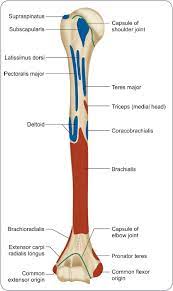 The humerus articulates with the scapula proximally at the glenohumeral joint so it participates in the movements of the shoulder. Also, the humerus has distal articulations with the radius and ulna at the elbow joint.
Right clavical
The clavicle is a sigmoid-shaped long bone with a convex surface along its medial end when observed from cephalad position. It serves as a connection between the axial and appendicular skeleton in conjunction with the scapula, and each of these structures forms the pectoral girdle. 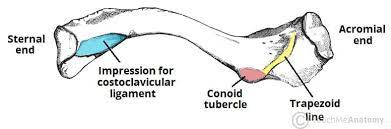
SCAPULA COSTAL SURFACE
The scapula is a flat, triangular-shaped bone (colloquially as the "shoulder blade"). It is located in the upper thoracic region on the dorsal surface of the rib cage. It connects with the humerus at the glenohumeral joint as well as the clavicle at the acromioclavicular joint to form the shoulder joint.
MANDIBLE BONE
The mandible is the largest bone in the human skull. It holds the lower teeth in place, it assists in mastication and forms the lower jawline. The mandible is composed of the body and the ramus and is located inferior to the maxilla. The body is a horizontally curved portion that creates the lower jawline.
MANDIBLE
The mandible is the largest bone in the human skull. It holds the lower teeth in place, it assists in mastication and forms the lower jawline. The mandible is composed of the body and the ramus and is located inferior to the maxilla. The body is a horizontally curved portion that creates the lower jawline.
Vault of skull
The vault of the skull is a region of the neurocranium formed by a process of membranous ossification. It consists of several bones: frontal bone, parietal bone, squamous part of the temporal bone, lamina ascendens of the sphenoid, and interparietal bone
NORMA BASALIS
Anatomy of the Skull: Norma basalis ( Anterior part , Middle part ) When the intact skull is viewed from below, the limits of the oral cavity can be seen. Its roof is formed by the hard palate; its walls by the upper and lower teeth embedded in the alveolar processes of the maxillae and the mandible