
Department of Community medicine
SHALLOW WELL

WELL
It is an artificial pit or hole, sunk into the earth to reach the
subsoil water. Different types of wells are:
- Shallow well
- Deep well
- Artesian well.
According to method of construction, wells are also classified into dug-wells and tube-wells.
SHALLOW WELL
Dug well is a well, which taps the water from Above the first impervious layer.
The term ‘shallow’ has nothing to do with the depth of the well
Shallow well water is liable for contamination from the surface.
The sources of pollution are surface-washings, drains, privy, cesspools, septic-tanks, etc.
If the soil is of porous nature, the impurities will also percolate into well and water becomes polluted.
The area which drains the pollutants or pathogens to well is called ‘Cone of filtration’ (Zone of influence) represented by an inverted cone, the apex being represented
by the bottom of the well and the base to the surface of the earth.
If there is any source of pollution within this area, contamination is likely to occur.
Usually, this area of drainage is four-times the depth of the well. Most of the wells in our country are shallow wells.
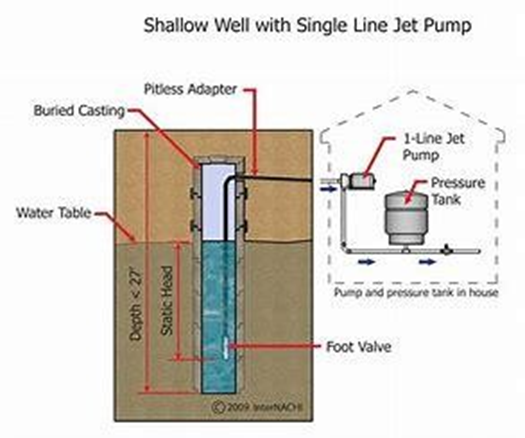
SHALLOW WELL
1. Taps the water from above the first impervious layer of earth
2. It is hard-water
3. It is liable for contamination
4. It is not safe water
5. Usually dries up during summer
6. Easy and cheap to construct
Pollution can be detected by introducing a solution of fluorescein and caustic soda (or paraffin oil or culture of Bacillus prodigious or solution of rhodamine. B) in this area and by examining the water at different of time for the testing material.